

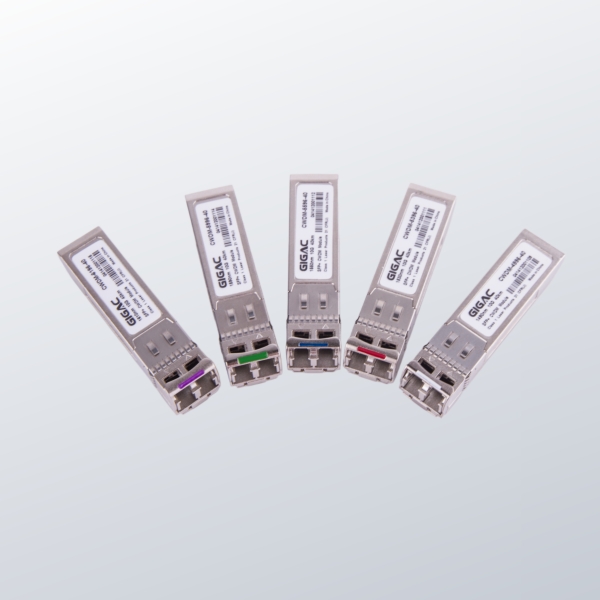
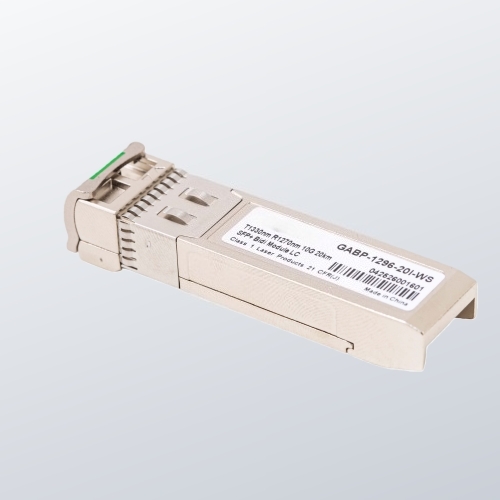
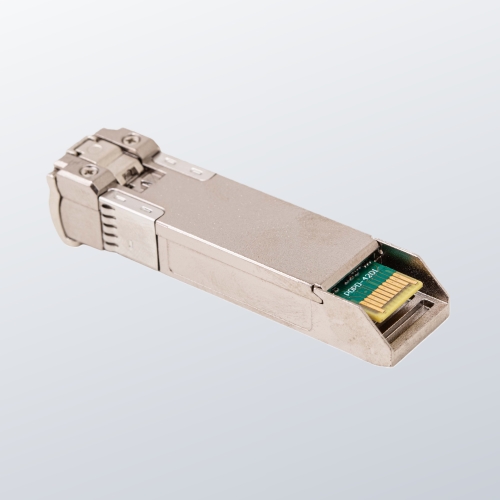
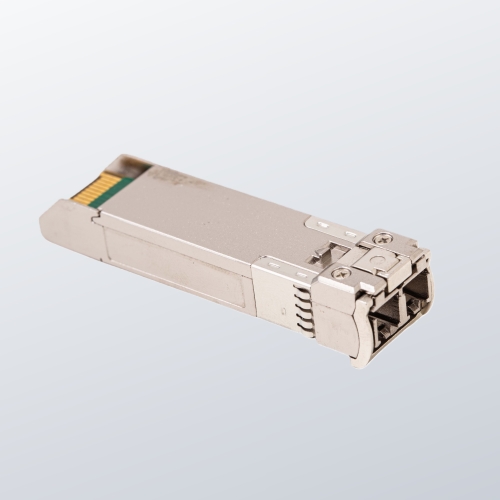
Products Description
The GIGAC 1.25G BiDi CSFP optical transceiver is designed for Gigabit Ethernet communication over single-mode fiber using bidirectional WDM transmission technology. By transmitting and receiving signals at different wavelengths over a single fiber, the module enables full-duplex communication while reducing fiber infrastructure requirements.
The module supports the IEEE 802.3ah 1000BASE-BX10 standard and provides reliable Gigabit optical links up to 10km. Integrated Digital Diagnostic Monitoring (DDM) allows real-time monitoring of optical power, temperature, voltage, and bias current, helping engineers maintain stable network performance.
The compact CSFP form factor maintains mechanical and electrical compatibility with standard SFP slots, enabling higher port density in networking equipment without hardware changes.
Quick Technical Specifications:
Data Rate | 1.25Gbps |
Standard | IEEE 802.3ah (1000BASE-BX10) |
Interface | LC/UPC Simplex |
Fiber Type | 9/125µm SMF |
Transmission Distance | Up to 10km |
Wavelength | Tx 1310nm / Rx 1490nm or Tx 1490nm / Rx 1310nm |
Transmitter | FP / DFB Laser |
Receiver | PIN Photodetector |
DDM | SFF-8472 Supported |
Power Supply | +3.3V |
Temperature | 0°C to +70°C |
Key Features:
• Data rate up to 1.25Gbps, compliant with 1000BASE-BX10 / IEEE 802.3ah
• Single-fiber bidirectional transmission (BiDi) — Tx/Rx on one fiber strand via WDM
• CSFP compact form factor, fully compatible with standard SFP slots
• LC/UPC simplex pluggable optical interface
• Up to 10km transmission over 9/125µm single-mode fiber
• FP laser transmitter (1310nm) / DFB laser transmitter (1490nm)
• PIN photodetector for reliable signal reception
• Integrated DDM (SFF-8472) — real-time monitoring of optical power, temperature, voltage, bias current
• Hot-pluggable design for zero-downtime maintenance
• Metal enclosure for low electromagnetic interference (EMI)
• Single +3.3V power supply
• RoHS compliant, lead-free construction
• Operating temperature: 0°C to +70°C (industrial option available)
Technical Advantages:
Single-Fiber BiDi Transmission
Using WDM technology, the module transmits and receives optical signals at different wavelengths through a single fiber strand. This reduces fiber infrastructure requirements by 50% and is particularly valuable in FTTH deployments, metro access networks, and retrofit projects where fiber availability is limited.
Compact CSFP Form Factor
The CSFP package provides the same electrical and optical interface as a standard SFP while enabling higher port density in switching equipment. Full mechanical compatibility with SFP slots means no hardware changes are required — simply plug in and deploy.
Integrated DDM Monitoring
The SFF-8472 compliant DDM interface enables real-time monitoring of five key operating parameters: transmit optical power, receive optical power, module temperature, supply voltage, and laser bias current. This allows network engineers to detect fiber degradation early, troubleshoot link issues faster, and reduce unplanned downtime through proactive maintenance.
Stable Gigabit Ethernet Performance
The module is optimized for Gigabit Ethernet transmission with carefully matched FP/DFB laser transmitters and PIN photodetector receivers. This provides stable, consistent optical link performance across the full 10km operating range for enterprise networks, access networks, and telecom equipment.
Low EMI Metal Enclosure
The metal housing provides effective electromagnetic shielding, reducing EMI emissions and improving immunity to external interference. Suitable for telecom central offices, data centers, and dense equipment racks where electromagnetic compatibility matters.
Typical Applications:
• Gigabit Ethernet access networks (1000BASE-BX10)
• FTTH / FTTB fiber-to-the-home and building deployments
• Metro and campus access fiber networks
• Switch-to-switch fiber uplinks
• Router and server fiber interfaces
• Switched backplane and chassis interconnect
• Telecom access equipment (OLT/ONU)
Compatibility & Deployment:
The module is designed for plug-and-play deployment in networking equipment with standard SFP slots supporting the 1000BASE-BX10 interface. Compatible with major networking platforms from leading OEM and ODM manufacturers. The LC/UPC simplex connector integrates directly with existing single-mode fiber infrastructure.
IMPORTANT: BiDi modules must be deployed in matched pairs.
• GACC-3412-10D — Tx 1310nm / Rx 1490nm (install at end A)
• GACC-4312-10D — Tx 1490nm / Rx 1310nm (install at end B)
One module of each type is installed at opposite ends of the fiber link. Sample testing and compatibility verification are available upon request.
Product Model Reference:
Model | Tx | Rx | Rate | Dist. | Fiber | Interface | DDM | Temp |
GACC-3412-10D | 1310nm | 1490nm | 1.25G | 10km | SMF | LC/UPC | Yes | 0~+70°C |
GACC-4312-10D | 1490nm | 1310nm | 1.25G | 10km | SMF | LC/UPC | Yes | 0~+70°C |
FAQ:
Q: What is a BiDi CSFP optical transceiver?
A BiDi (bidirectional) CSFP transceiver is a compact optical module that transmits and receives data over a single fiber strand using two different wavelengths. The CSFP form factor is mechanically compatible with standard SFP slots, offering the same functionality in a smaller package suitable for high-density deployments.
Q: What is the difference between GACC-3412-10D and GACC-4312-10D?
These two models form a matched BiDi pair. The GACC-3412-10D transmits at 1310nm and receives at 1490nm, while the GACC-4312-10D transmits at 1490nm and receives at 1310nm. One of each is required at opposite ends of a fiber link for bidirectional communication.
Q: Is this module compatible with standard SFP slots?
Yes. The CSFP form factor maintains full mechanical and electrical compatibility with standard SFP slots. No special adapters or hardware modifications are required. It works with any equipment that supports 1000BASE-BX10 SFP modules.
Q: What does DDM mean and why is it important?
DDM (Digital Diagnostic Monitoring) per SFF-8472 allows real-time monitoring of optical power, temperature, laser bias current, and supply voltage directly through the module. This helps network operators detect fiber degradation early, troubleshoot link issues faster, and reduce unplanned downtime.
Q: Can this module be used in FTTH deployments?
Yes. The single-fiber BiDi design is particularly well suited for FTTH applications, as it halves fiber cabling requirements between the OLT and ONU. The 10km reach covers typical last-mile and metro access distances.
Our factory

Industrial Optical Module Assembly Line

High-Precision Fiber Assembly

Automated Manufacturing for Consistency

100% Functional & Reliability Testing